
Migrations Clean House Once. Governance Keeps It Clean.

Recently ServiceRocket published a story worth sitting with. A global sports technology firm had just come out of an acquisition holding two separate Atlassian environments, and by the time the migration wrapped, they'd taken their Jira footprint from roughly two million issues down to about thirty-two thousand. Workflows dropped from two hundred and eight to a hundred and seventy-one. 98% of the clutter, gone, in a single Atlassian Cloud migration.
98%. Read that number twice and it starts to raise an obvious question. How did an organization end up with two million issues in the first place?
It happened the way it always happens: one ticket at a time, one workflow tweak at a time, over years, across teams that had no reason to look back and ask whether last year's project still needed a paper trail. Add an acquisition on top of that, with a second company's Jira instance app-linked to the first, and the number stops being surprising… it becomes inevitable.
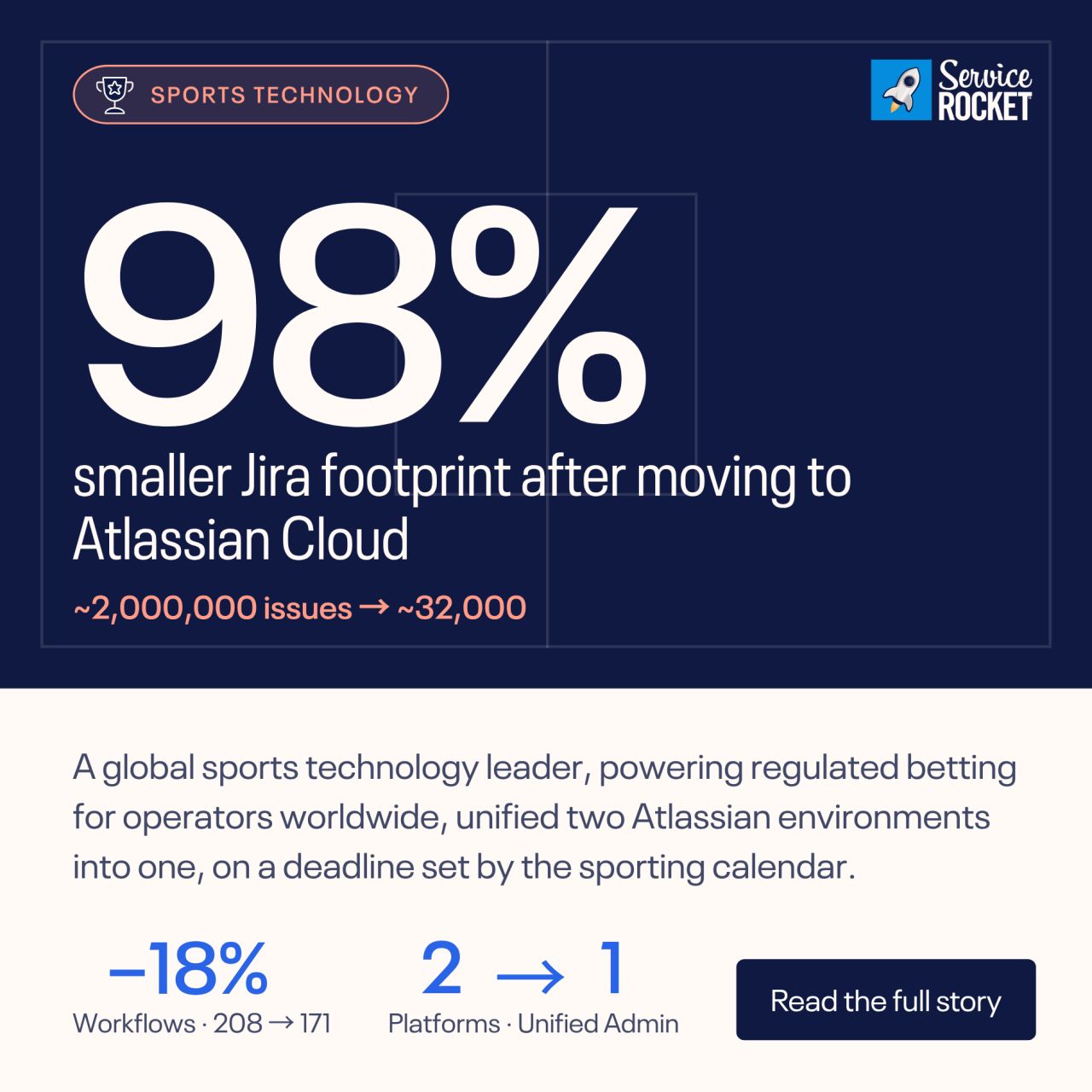
ServiceRocket's team did exactly what you'd want a migration partner to do. They assessed the environment, asked what really needed to be retained, and right-sized it by pulling out what was unused or redundant. Then they validated the result across multiple rounds of testing, and consolidated two legacy platforms into one via the migration. The project finished ahead of schedule and without disrupting the business, which is no small feat when you're touching two million records. Their client walked away with a leaner, cheaper, more defensible Jira instance, and a repeatable playbook for next time.
This story usually stops after the successful migration. But the same pressures start building up again immediately, and 18 months from now, that same environment has been filling back up. Not through negligence. New projects get created and never archived. Old workflows get copied for new teams, and never retired. Tickets tied to systems that no longer exist just sit there, because deleting them wasn't anyone's job and “losing them” felt riskier than leaving them alone. Multiply that by a few more years and another acquisition, and you're looking at another engagement much like the one ServiceRocket just delivered.
We think that's the real lesson buried in this story, and it's one we've built a company around. A migration is a single, expensive moment of discipline. What prevents the next one being so expensive is discipline that continues routinely, and automatically.
That's the gap Content Retention Manager sits in. Instead of waiting for licensing costs or an audit deadline to force a cleanup, it applies retention rules continuously, in Confluence and in Jira, so content ages out on a schedule your organization actually set rather than piling up until someone notices the bill. Old tickets tied to closed projects get retired according to policy. Stale pages get flagged, archived, or deleted the same way. None of it requires a project plan or a vendor engagement six months from now. It just runs, quietly, and continuously.
Now there's a newer reason this matters, one that wasn't really part of the conversation even two years ago. Organizations are pointing AI tools at their Confluence spaces and Jira spaces (fka projects!) and asking them to summarize, answer questions, and make recommendations. Those tools are only as good as what they're reading. An AI trying to reason across millions of issues, half of them abandoned, is working with the same kind of noise a new employee would face on their first day, except the AI won't know to ask a colleague which parts to ignore. A current, right-sized knowledge base isn't just cheaper to license and faster to operate. It's the difference between an AI assistant that's actually useful and one that confidently repeats something that stopped being true three reorganizations ago.
ServiceRocket and Opus Guard work well together for exactly this reason. They handle the migration, the assessment, the heavy technical lift of moving an organization from one state to another cleanly. We handle what happens after, making sure the clean state a migration delivers isn't a snapshot that starts decaying the day the migration project closes.
If your Jira or Confluence instance is heading toward its own two-million-issue moment, or you'd rather it never got there, take a look at what continuous retention policy actually looks like in practice. It's a smaller conversation than a migration, and it's one you can have before the bill arrives instead of after.
Source: ServiceRocket, "Global Sports Firm Unifies Operations with Atlassian Cloud Migration Governance".
Get started today
Related posts

Tome el control de sus datos hoy mismo
Decida qué puede leer su IA. Comience gratis con hasta 10 usuarios u obtenga una prueba de 30 días para equipos de cualquier tamaño.